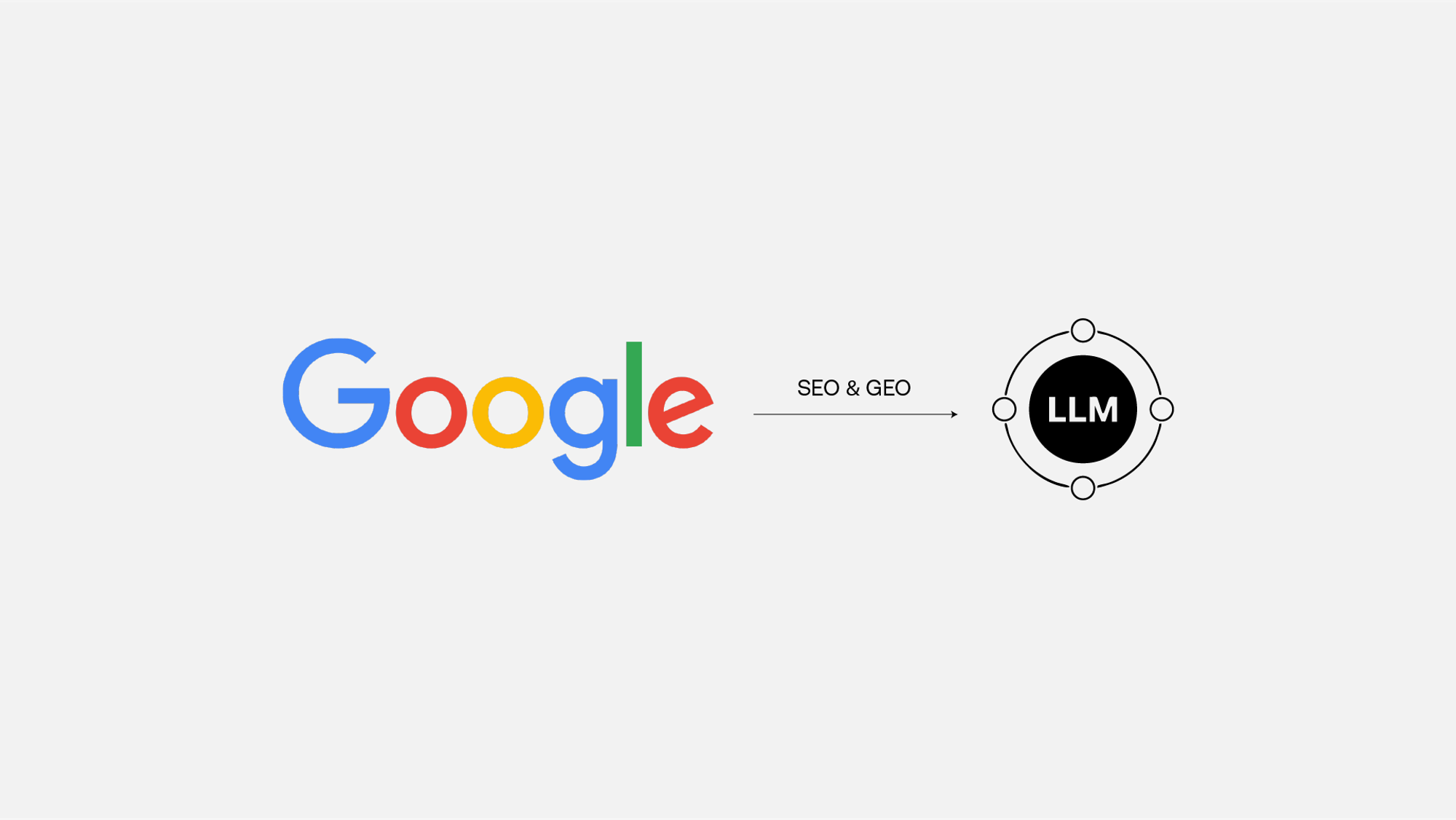
Today, too many websites are still built backwards. You start with the visual direction, move through a few mockups, sign off on a homepage, then "add SEO" later. As if visibility were a secondary layer. As if it could be grafted on at the end without affecting the substance.
The problem is that a website doesn't become clear, indexable, and citable by accident. It must be designed from the start to be understood on three levels at once: by users, by search engines, and by AI-powered interfaces that now synthesize information. Google itself reminds us that the fundamentals remain the same: accessible content, exploitable structure, indexable pages, and genuinely useful information. AI Search features rely on these same foundations.
In other words, thinking SEO and GEO from the start isn't about "optimizing more." It's about building smarter.
SEO allows a website to be found.
GEO pushes an additional requirement: ensuring content is clear, reliable, and well-structured enough to be picked up, summarized, or cited in AI-enhanced search experiences. Google explains precisely that its AI features rely on the same quality systems as Search, making structure, readability, and reliability even more important.
Put simply, a website designed for SEO and GEO isn't a keyword-stuffed site. It's a site that clearly expresses what it does, for whom, with what method, and why it's worth visiting.
Think structure before pages
The first mistake is thinking page by page.
The right approach is to think in terms of information architecture first.
Before even discussing interface, you need to know which search intents the site must cover, which pages deserve to exist, how they complement each other, and in what order they should be understood. Google's SEO Starter Guide emphasizes the importance of logical organization, descriptive titles, and navigation structure that helps both users and search engines.
A well-conceived site doesn't just stack a homepage, some services, and a contact page. It builds a clear map:
- a central promise,
- well-named service pages,
- useful editorial content,
- proof points,
- and a coherent internal linking structure.
This logic is what allows Google to better understand each page's role, and AI interfaces to better identify what deserves to be referenced.
Create pages that answer a real question
Traditional SEO has long been obsessed with keywords.
GEO forces you to go further: every page must also be answerable.
This means a service page shouldn't just be beautiful or well-written. It must clearly answer an intent. What is a visitor looking for when they land here? A definition? A method? A comparison? A budget? Proof? A concrete case?
Google recommends creating content that is "helpful, reliable, people-first": useful, trustworthy, and designed for humans first. It also clarifies that using AI isn't a problem in itself, but producing numerous pages without added value can fall into spam territory.
This is a key point for Junca: good SEO/GEO content isn't inflated text. It's text that formulates a clear answer, with a real point of view, in an easy-to-understand structure.
Make content readable by engines and humans alike
A website designed for SEO and GEO must be readable in the strong sense.
Not just pleasant to browse. Readable in its structure.
This means explicit titles, coherent H1/H2/H3 hierarchy, paragraphs that develop one idea at a time, precise vocabulary, and a hierarchy that helps quickly understand the topic. Google explains that its system relies on content actually accessible on the page, and that its crawlers must be able to discover, explore, and interpret that content correctly.
In a GEO context, this readability becomes even more important. A confusing page is hard to summarize. A vague page is hard to cite. A page that's too "marketing" without substance is hard to consider a real answer.
In other words, what search engines increasingly value isn't just the presence of information. It's the quality of its organization.
Anticipate technical issues before they become blockers
Many SEO problems arrive too late: poorly accessible injected content, weak HTML structure, poor tag management, blocked pages, poorly controlled snippets, missing or misused structured data.
These issues shouldn't appear at the end of a project. They should be planned from the design phase.
Google specifically recommends using structured data when relevant, preferring JSON-LD format, to help its systems better understand page content. It also notes that no rich display is guaranteed, even when markup is correct. Meta tags and snippet control rules also play a role in how content can be presented.
This means a well-designed SEO and GEO site plans from the start:
- clean HTML structure,
- genuinely indexable content,
- useful tags,
- appropriate structured data,
- and clear governance over what Google can display or not.
SEO isn't a plugin.
It's a design layer.
Think brand and visibility together
The most common mistake is opposing brand design and organic performance. As if a website had to choose between being premium and being findable.
In reality, the best websites combine both.
A great brand website can be visually stunning while remaining clear in its promises, precise in its headings, rigorous in its pages, and useful in its content. This is often what makes the difference: a brand that owns its universe, but also knows how to clearly articulate what it delivers.
At Junca, we defend exactly this idea: a website designed for SEO and GEO shouldn't look like a keyword machine. It should remain a brand experience. But a brand experience that knows how to make itself understandable, interpretable, and credible.
What this concretely changes in a web project
Thinking SEO and GEO from the start changes how a project is framed.
You no longer start only with art direction.
You also start with:
- search intents to cover,
- strategic pages,
- proof to make visible,
- questions the site must answer,
- editorial linking,
- and how each page can exist for both a human and a search engine.
This also changes the writing.
Good web copy no longer just needs to "sound right." It also needs to be structured for quick comprehension, easy extraction, and logical connection to other site content.
Put differently: a website designed for SEO and GEO isn't a more rigid site. It's a smarter site in its construction.
The Junca perspective
At Junca, we believe a great website should never have to choose between visibility, clarity, and desirability. When SEO is added too late, it corrects.
When it's planned from the start, it structures.
And when this logic extends to GEO, it pushes the site to be even sharper in how it names, explains, and prioritizes.
This is also why we see design as a discipline of clarification, not just aestheticization. A strong website isn't just a beautiful website. It's a website that expresses an offer with enough precision to be understood by a visitor, enough quality to convince, and enough structure to be correctly interpreted by search engines.
Conclusion
Building a website designed for SEO and GEO from day one isn't adding another constraint to the project.
It's avoiding a methodological mistake.
A website doesn't gain visibility because you add a few optimizations at the end. It gains organic performance when its structure, content, hierarchy, and technical foundation are designed together.
The real challenge isn't to "do SEO."
The real challenge is to build a site clear enough to be found, useful enough to be consulted, and well-structured enough to be understood, referenced, and cited.
And today, that's probably where a good website begins.
What's the difference between SEO and GEO?
SEO targets visibility in search engines. GEO aims to make content more easily understandable, synthesizable, and citable in AI-enhanced search experiences. Google indicates that these features rely on the same quality foundations as Search.
Should you think about SEO from day one?
Yes. Google recommends clear foundations from the start: accessible content, logical structure, useful navigation, and indexable pages. Fixing these issues after the fact usually costs more and works less well.
Is structured data mandatory?
No, but it can help Google better understand a page and make it eligible for certain enrichments. Google specifically recommends JSON-LD, while noting that no rich display is guaranteed.
Can a highly designed site be good for SEO and GEO?
Yes, as long as the design serves clarity, hierarchy, and content accessibility. A visually strong site doesn't need to be vague to be premium.
Can AI help produce SEO content?
Yes, but Google clarifies that what matters is user value. AI can help structure or accelerate, but mass-producing pages without added value can be problematic.