Awwwards gave its Site of the Day award to three deeptech companies on three consecutive days this September: Seasats on the 8th, USAvionix on the 9th, Cerebrium on the 10th. Autonomous boats, jet drones, real-time AI infrastructure. A jury that used to crown fashion lookbooks is now crowning hardware, and that says something about where design attention has moved.
We build these sites. Hylight came to us during Y Combinator S23 with hydrogen airships to explain, BotBlox with networking hardware for drones, satellites and subsea robots. So we went through the deeptech companies that have won Site of the Day and kept twelve. For each one: what the company does, what the site actually gets right, and what you can take from it.
How we picked these twelve websites
Site of the Day only. It is the top daily distinction on Awwwards, scored by a jury on design, usability, creativity and content, and a list about the best cannot run on second place. That rule costs us some famous names: several celebrated defense and robotics homepages hold an Honorable Mention from 2020 or 2024, awarded to a version of the site that no longer exists. Citing them today would be citing a ghost.
Every URL, award date and score below was read off the Awwwards entry page, and every site was opened and scrolled. We name the companies and their sites, never the studios behind them.
They show the hardware instead of describing it
The fastest way to make a technology believable is to let people look at it. These three refuse to hide the machine behind a metaphor.
1. Vast
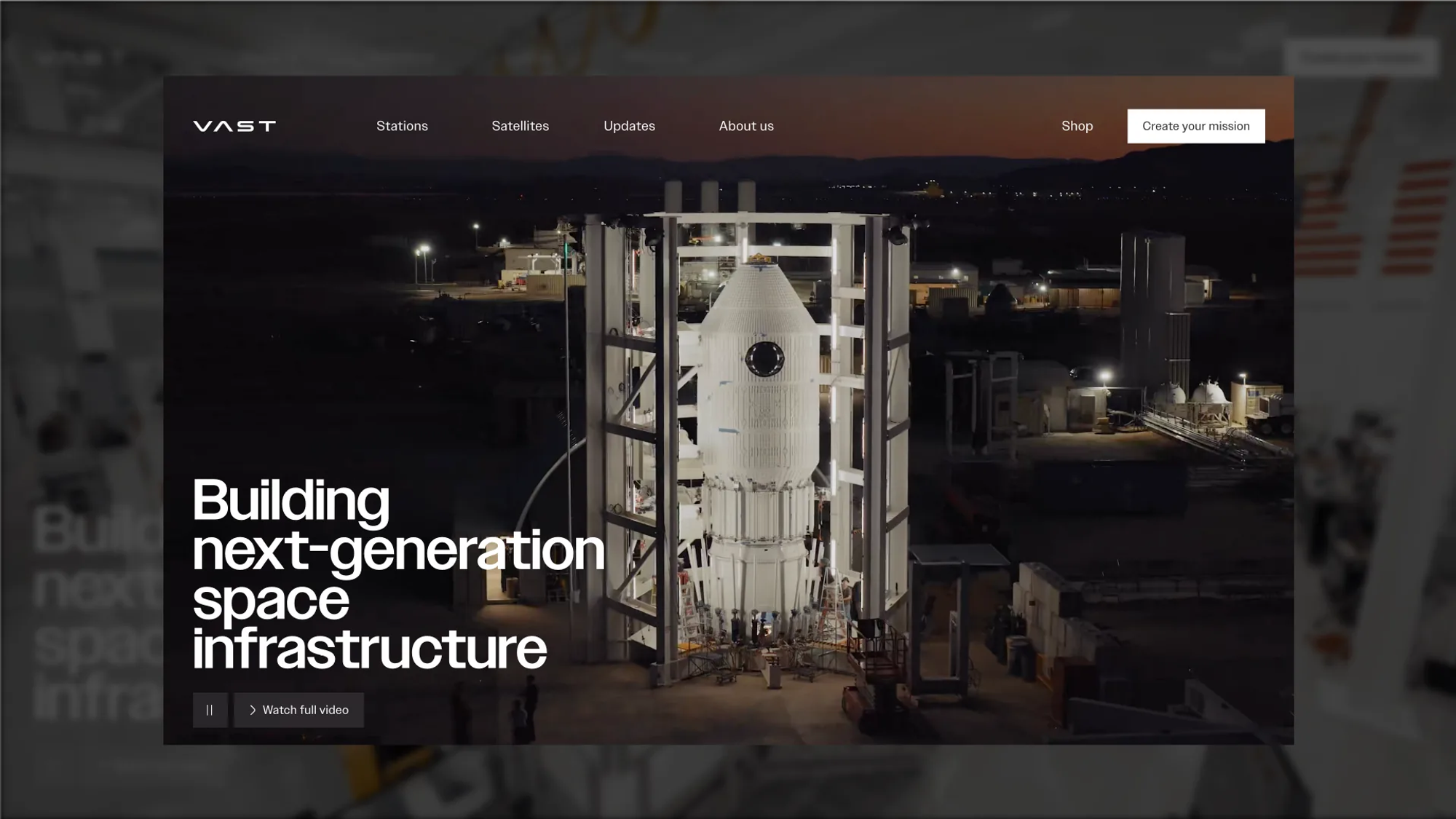
Vast builds commercial space stations and won Site of the Day on April 1, 2026 with the highest score in this list, 7.65 out of 10. The homepage opens on a photograph taken inside the real Haven-1 module, not a render, then hands over the spec block immediately: 4 crew, 10.1 m tall, 45 m³ of habitable volume, a 425 km orbit, launch targeted for 2027. The lesson: when your hardware exists, photograph it. Nothing a 3D artist produces beats the proof that the thing is already welded.
2. Seasats
Seasats builds solar-electric autonomous boats in San Diego and took Site of the Day on September 8, 2026 with 7.44. The headline refuses abstraction: "Ocean Autonomy That Works". Three vessels then get three identical spec blocks, Lightfish at 305 lbs with 8,000 nautical miles of range, Quickfish at 35+ knots, Heavyfish at 9,000 lbs, followed by a page of past missions. The lesson: a buyer comparing platforms wants the same fields in the same order. Comparability is a design decision, not a content one.
3. Fauna Robotics
Fauna Robotics makes the humanoid robot Sprout and won Site of the Day and Product Honors on June 16, 2026 with 7.39. There is not a single specification on the homepage. Instead: "Capable, safe, fun. Robots for everyone", then photographs of Sprout sitting on a workbench in a real lab, cables visible, an engineer working beside it. The numbers live one click away in a technical report. The lesson: when a product is unfamiliar, familiarity beats performance.
They design the number, not just the claim
Every deeptech site has metrics. These three treat a number as something to be understood rather than displayed.
4. Cerebrium
Cerebrium runs serverless infrastructure for real-time AI and took Site of the Day on September 10, 2026 with 7.39. Its strongest section is a cold-start comparison: 3.8 seconds with Cerebrium snapshots, 71 seconds on a competing provider, 156 seconds on EKS or GKE. The claim is falsifiable, the units are visible, and the reader does the arithmetic alone. The lesson: one honest benchmark, with the alternatives named by category, does more than a page of adjectives.
5. ON Energy
ON Energy builds hyperscale power systems for data centers and won Site of the Day on March 9, 2026 with 7.44. The headline runs five words, "Perfect Power for AI Factories", and the proof follows as a row of figures: 3 GW+ operating and under construction, 10+ GW of production capacity, 75+ projects, 99.9% uptime. The lesson: name the customer in the headline. "AI factories" tells a data center operator the page is for them faster than any description of the technology could.
6. Caeli Energie
Caeli Energie makes low-carbon air conditioning in France and took Site of the Day on September 21, 2025 with 7.21, the only European company in this list. One number carries the argument: a COP of 16, meaning 16 watts of cooling per watt consumed, from a unit drawing 30 to 80 watts. The lesson: translate the metric in the same sentence. A COP of 16 means nothing on its own and everything next to "five times a conventional air conditioner".
The interface becomes the product demo
When the product is autonomy, software or a moving machine, the website can behave like the thing it sells instead of describing it.
7. USAvionix
USAvionix builds long-range autonomous jet drones and won Site of the Day on September 9, 2026 with 7.41 and a 7.74 developer score, built with 3D and WebGL on Next.js in a palette of exactly two colors. The page boots like an avionics system, then runs three named mission scenarios, Wildfire Cascade, Border Storm and Critical Infrastructure, with live telemetry beside them: 1,240 m altitude, 74 km/h, 32 cars and 2 UAVs detected. The lesson: if your product is an interface, let the website behave like one.
8. Serve Robotics
Serve Robotics runs autonomous sidewalk delivery and took Site of the Day on June 11, 2026 with 7.30. The detail worth stealing is the loading screen: two cyan circles blinking on dark green, which are the robot's eyes. Before a single word has rendered, the brand has introduced its character. The lesson: a robot that people will meet in physical space needs a face, and the smallest moments of a site are where that face gets established.
9. Waabi
Waabi develops self-driving trucks and won Site of the Day on March 7, 2026 with 7.24 and a 7.64 developer score. The hero reads "Built to think. Born to haul.", with "think" and "haul" set in a lighter tone so one sentence carries two readings at once over a photograph of the truck. Momentum sits in the same view: $1 billion raised in January 2026, 80% growth on a named long-haul corridor in September. The lesson: typography can hold a dual message, and a funding round is a design element.
They give an abstract ambition a physical scale
Energy, compute and climate are hard to picture. These three attach something concrete to an argument that would otherwise float.
10. Hut 8
Hut 8 operates high-density data centers for AI, cloud and Bitcoin mining, and won Site of the Day with a Developer Award on October 28, 2025 with 7.63. The page is black, the type condensed, the scale contrast extreme: "Where Power Unlocks Potential" at display size, the substance in small print below it, 205 MW of capacity, a 500 MW site under construction, a $19.6 billion contract. The lesson: typographic scale tells a reader what to read first when a page carries both a vision and a balance sheet.
11. ZettaJoule
ZettaJoule builds advanced nuclear reactors for heavy industry and took Site of the Day on May 30, 2026 with 7.25. The hero is a 3D render of the reactor core, chromed fuel assemblies passing in front of and behind the words "Powering the World". The specification anchors the ambition: 30 MWth, heat up to 950 °C, some 600 °C above a water-cooled reactor. The lesson: when nobody can visit your machine, model it. That was the case for Hylight, whose airship existed in 3D long before anyone saw one fly.
12. Breakthrough Energy
Breakthrough Energy is a clean energy innovation platform and won Site of the Day on January 15, 2026 with 7.38 and the highest developer score in this list, 7.94. It opens on lab footage lit in orange, then states the stake as one comparison: 27,000 TWh of electricity demand in 2024 against 51,000 TWh projected for 2050. The portfolio is then counted by sector: 29 companies in manufacturing, 26 in electricity, 20 in agriculture. The lesson: a number becomes an argument the moment a second number sits beside it.
What the twelve have in common
None of them won on decoration. Strip the motion away and the same four moves remain, which is why we read this list as a specification rather than a mood board.
- Every claim arrives with its unit: megawatts, terawatt-hours, nautical miles, degrees Celsius. Vagueness is the first thing these sites refuse.
- The hardware is shown, not described: a photograph when it exists, a render when it cannot be visited, never a stock image of a server room.
- The buyer is named early: AI factories, heavy industry, ISR operators. Naming the reader filters better than explaining the technology.
- Depth is one click away and never forced: spec sheets and technical reports sit behind the story rather than interrupting it, the layered approach we set out in how to explain complex technology on a website.
The stack is not the differentiator. These twelve run on very different foundations, and so does our own work: we build this kind of site in Framer or in custom code with Astro and Next.js depending on the project, and the site you are reading runs on Astro, Sanity and Three.js. What separates the twelve from everyone else is that somebody decided what a visitor had to understand, and in what order, before anything was designed.
The honest caveat: several of these sites open on a preloader or an intro animation, and that cost is real. An award jury waits for the show to finish. An investor checking you from a phone between two meetings does not, which is the tension we described in what VCs actually look at before a Series A.
The checklist we would run on your site tomorrow
- A visitor can name your buyer, your product and its stage of maturity in under ten seconds.
- Every headline number carries its unit and a comparison.
- Your hardware appears as a photograph, a render or a diagram before the first scroll.
- Spec sheets exist, and reaching them takes exactly one click.
- Your latest milestone, round or deployment is visible without opening a news page.
- The page is readable and usable before any animation has finished.
Not one of these companies got here by briefing a website. They decided what a stranger had to believe, then built the page around that decision. If that is the work in front of you, our approach to web design for deeptech startups lays out how we run it, and if you would rather just look at your site together, talk to us.