













You know the site underperforms. You don't know which ten things to fix first.
A website audit that ranks every SEO, speed and AI-search issue by impact

What it is
A website audit measures what stops a site from being found, read and trusted: how search engines crawl and index it, how fast it is for real visitors, how its pages answer the questions buyers ask, and what AI assistants say about the company.
Junca audits tech and deep tech websites built in any tool, ranks every issue by its impact and turns the result into a plan your team, or ours, can act on.
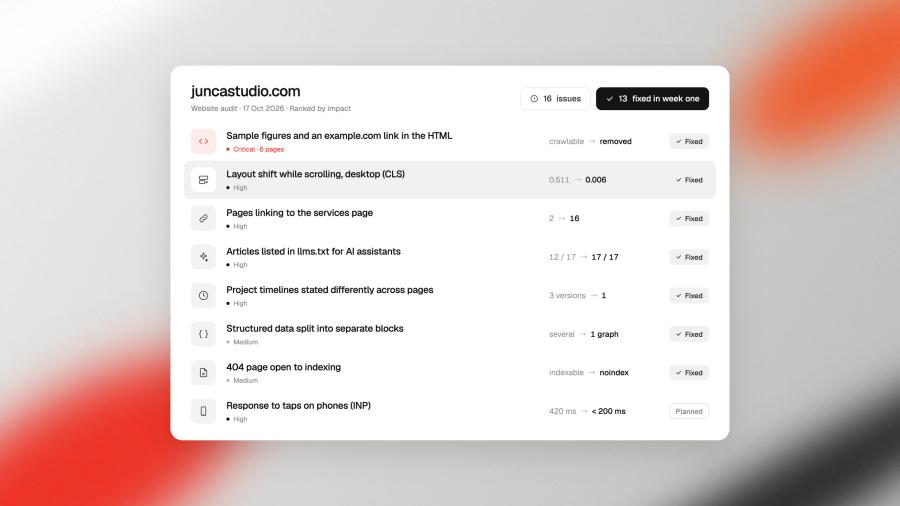
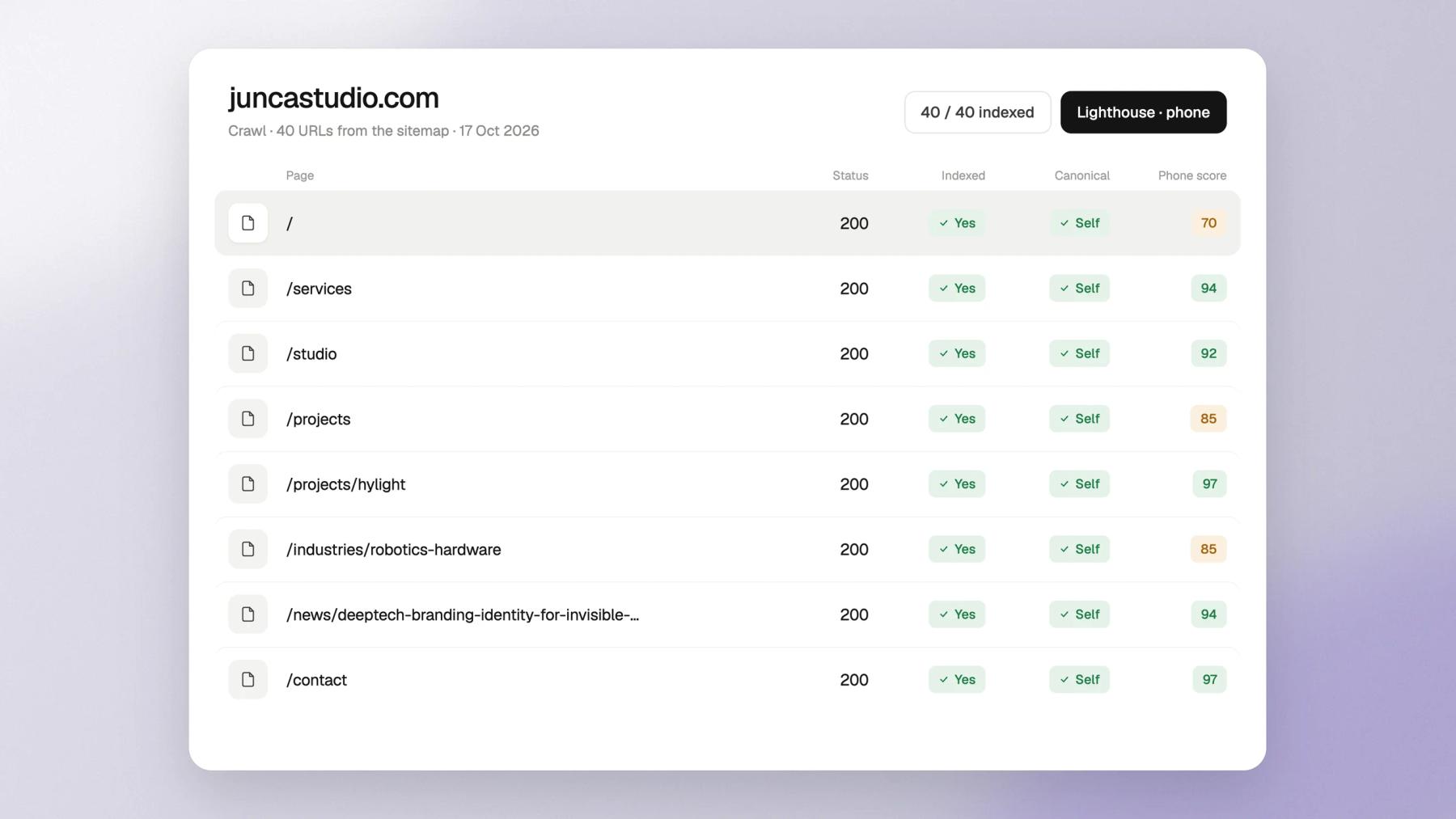
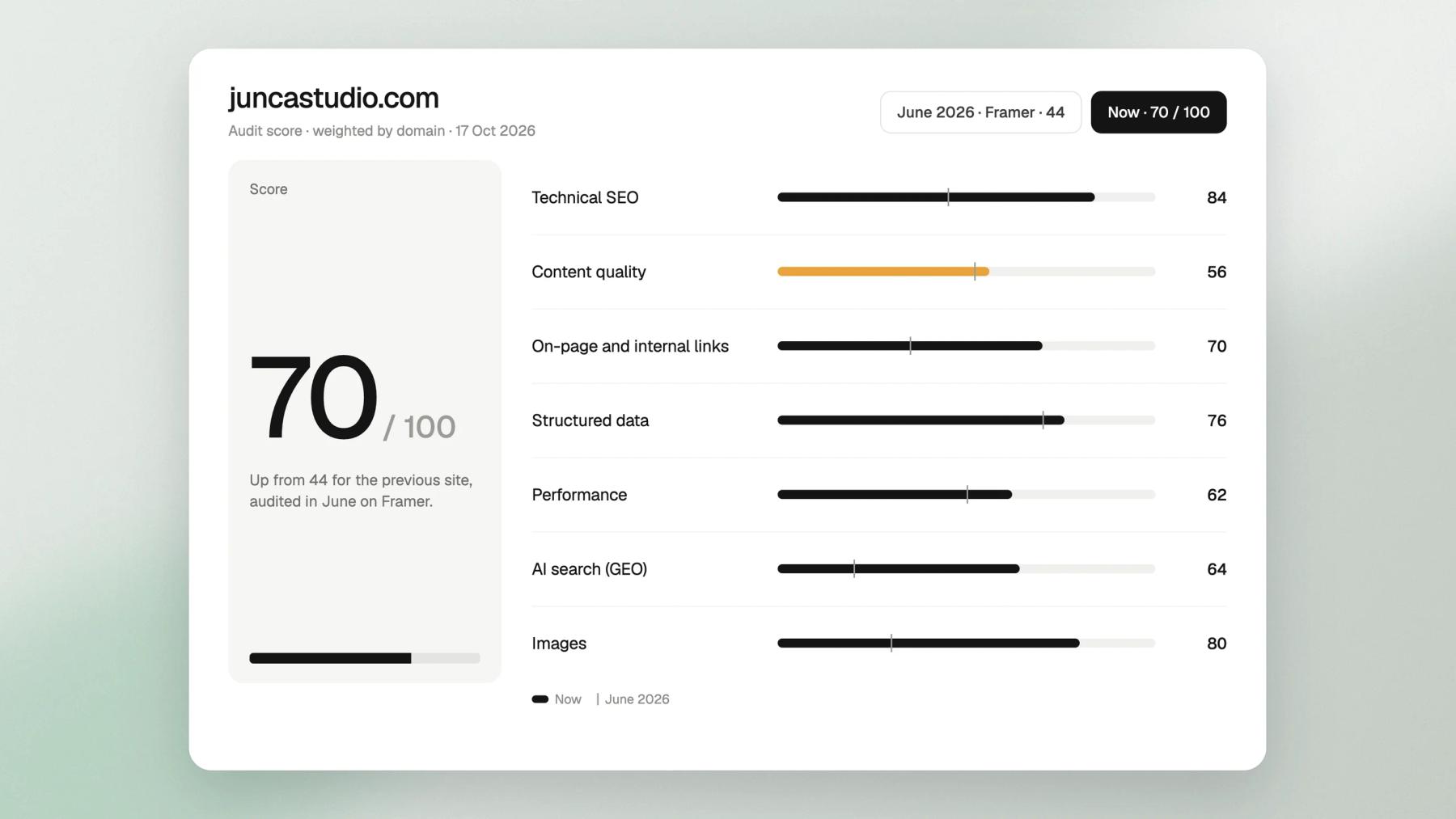
We ran the same audit on our own site on 17 October 2026: forty pages crawled, sixteen months of Search Console, field data from real Chrome visitors and AI answers checked. It scored 70 out of 100, against 44 for our previous site in June, and thirteen of the sixteen first-week issues were fixed that week.
The problem
Your site has a score. It does not have a plan.
Why most website audits change nothing
Automated reports list hundreds of warnings at the same level, measured on a fast laptop, with nothing about AI assistants and no one named to fix anything. The audit is filed, the site stays the same.
The traps
Trap 0101 / 05

Everything at the same level
Two hundred warnings, no order
Tools flag every missing alt text as loudly as a page Google cannot read. We rank each issue by its impact on search, speed and AI answers, so the first week goes to what matters.
Trap 0202 / 05
Lab, not field
Speed measured on a fast laptop
A lab score of 98 on a developer's machine says little about a buyer on a phone. We read field data from real Chrome visitors next to the lab, page by page and device by device.
Trap 0303 / 05
Nobody asked
AI assistants left out
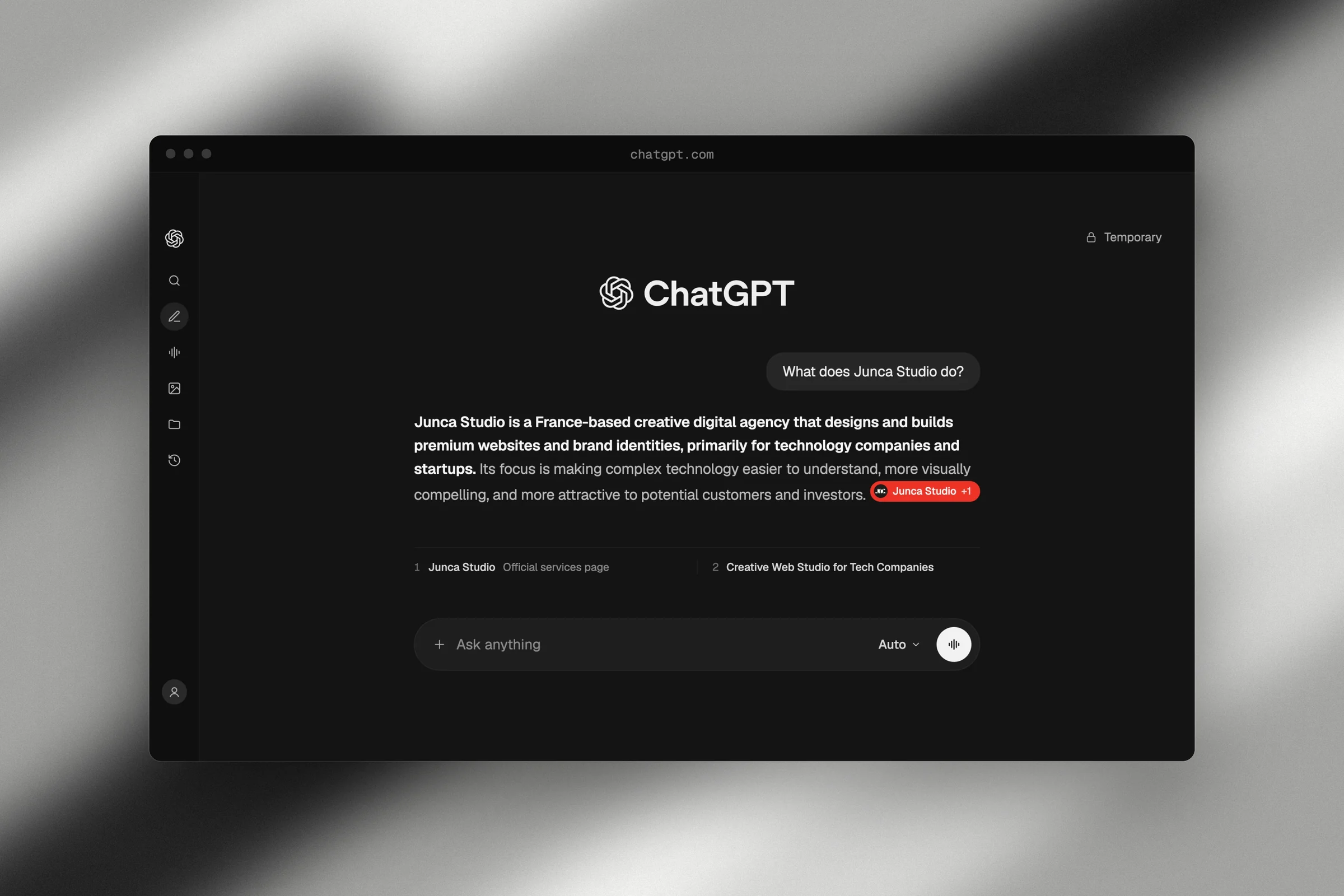
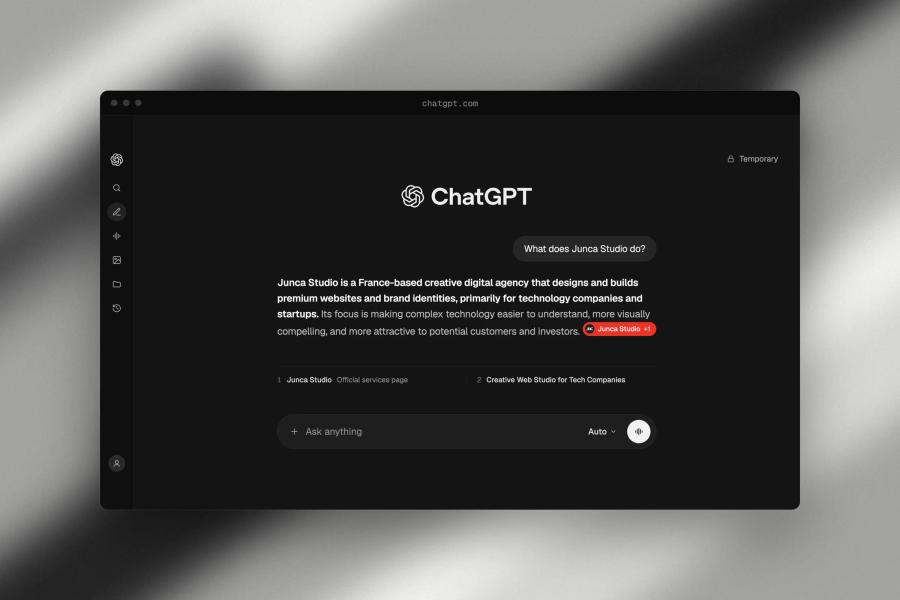
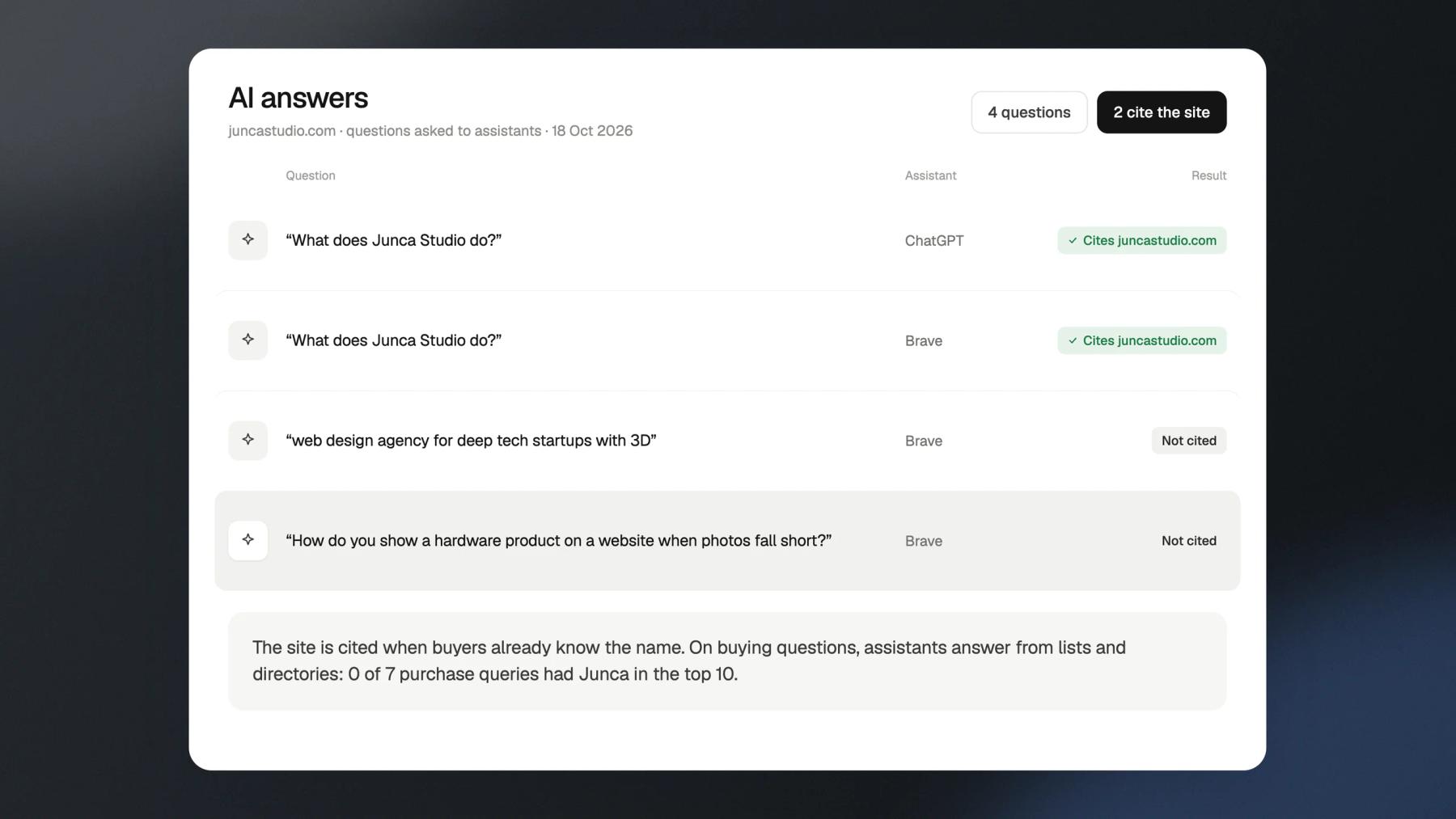
Most audits stop at Google, while buyers now ask ChatGPT and other assistants for a shortlist. We ask them your buyers' questions and record whether you appear, how you are described and which pages are cited.
Trap 0404 / 05

Brand traffic only
Traffic that only knows your name
Many tech sites rank for their own name and little else: ours had 2 non-brand clicks in 28 days. We separate brand and non-brand searches before judging anything, then show where the next buyers could come from.
Trap 0505 / 05

Filed and forgotten
An audit nobody implements
A report without owners or effort stays in a drive. Every issue in ours comes with the fix, the effort and who makes it: your team, ours or the developer you already work with.
The process
How we audit a tech company's website
The audit is run by the team that designs, builds and ranks sites, so every finding comes with a fix we would make ourselves. You follow it in the Junca client portal, with the data, the ranked issues and the plan in one place.
Step 01
Crawl
Every page crawled the way a search engine sees it: status, indexing, canonicals, structured data, titles and lab speed, page by page.
Step 02
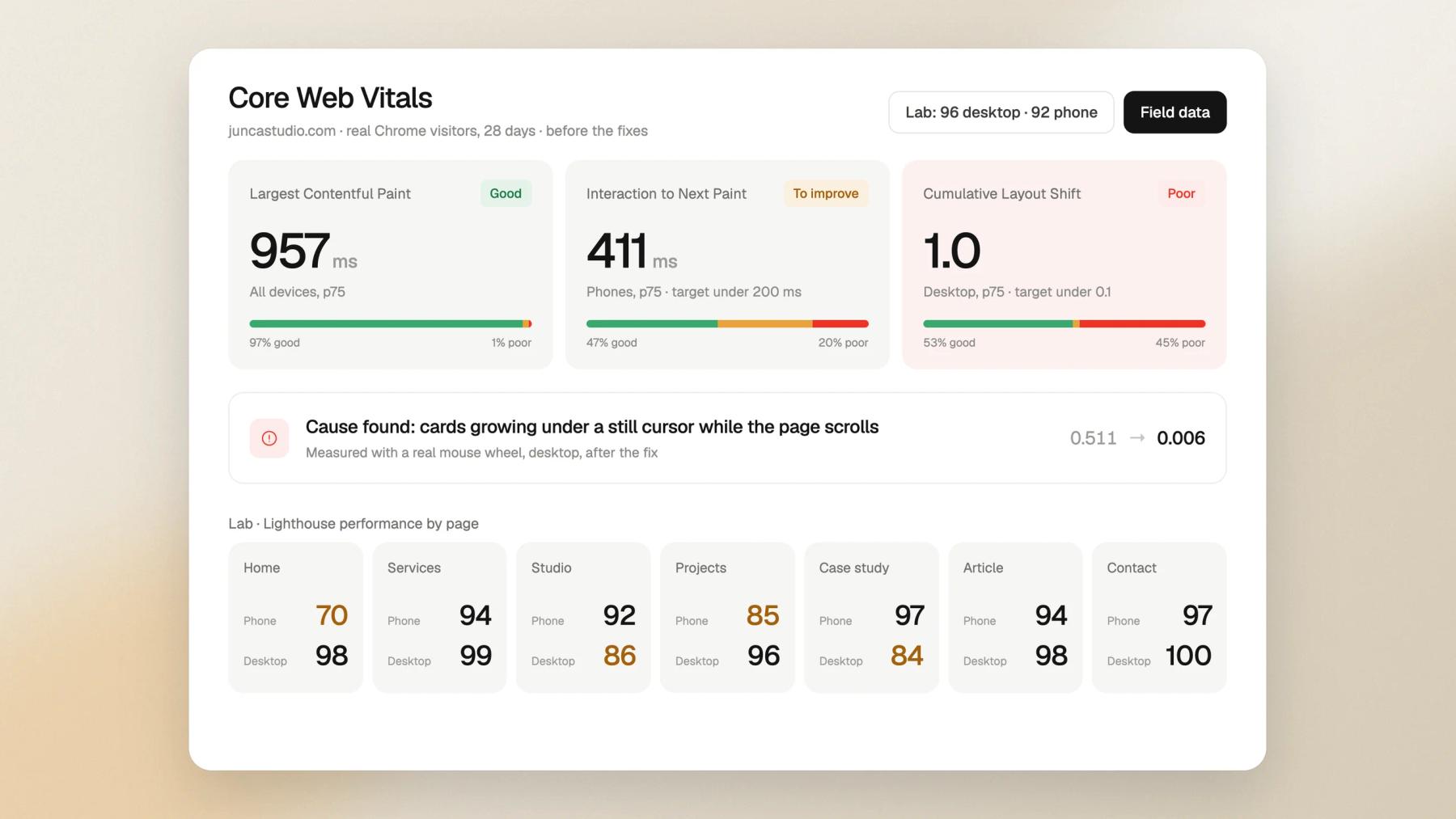
Field data
Core Web Vitals from real Chrome visitors, read next to the lab, with the cause of each problem traced to a component.
Step 03
AI answers
Your buyers' questions asked to AI assistants, with and without your name, to see whether you are cited and how you are described.
Step 04
Score and rank
A score by domain, then every issue ranked by impact, with the fix, the effort and who makes it.
Step 05
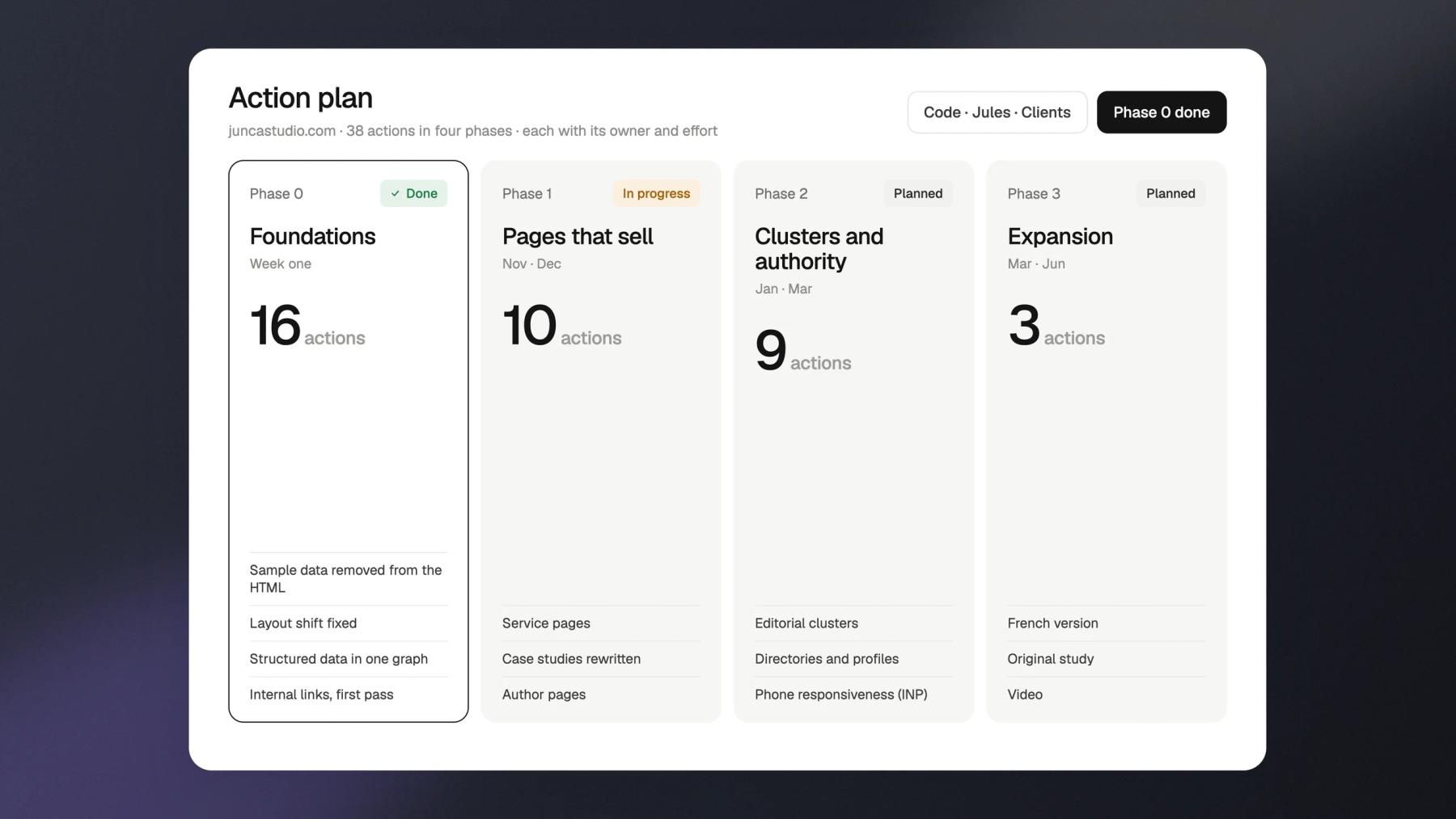
Action plan
The fixes grouped into phases, from what to change in the first week to the pages and content of the next months.
What you get
Everything the project needs, from one team.
Audit report
Findings by domain, from technical SEO to AI answers, with the evidence behind each one.
Ranked issue list
Every issue ranked by impact, with the fix, the effort and who makes it.
Core Web Vitals review
Field and lab data page by page, and the cause of each slow or unstable page.
AI visibility check
Your buyers' questions asked to AI assistants, and what they answer about you.
Search Console review
Brand and non-brand searches separated, with the pages and queries that could grow.
Action plan
The fixes in phases, from the first week to the next months, ready for your team or ours.
What does a website audit cover?
Technical SEO (crawling, indexing, redirects, structured data), page content and internal links, speed for real visitors, images, and what AI assistants answer about you. Each domain gets a score, and each issue a fix, an effort and an owner.
Do you need access to our accounts?
Read access to Search Console helps a lot: it holds sixteen months of searches, clicks and indexing data. Analytics is useful but optional. We do not need access to your CMS or your code to run the audit.
Can you audit a site you did not build?
Yes. We audit sites built in Framer, Webflow, WordPress, Squarespace or custom code. When the platform itself is the limit, we say so and explain what a migration would change.
What happens after the audit?
Your team can implement the plan on its own, since every fix is written for whoever makes it. Or we take it on, as part of SEO and AI search work, a redesign or a migration.
Is an audit useful before a redesign?
Yes, it is the best time. It tells you which pages rank and must keep their address, what the new site has to fix, and which content to carry over, before anything is designed.
How do you check AI answers?
We ask the main AI assistants the questions your buyers ask, with and without your name, and record whether you appear, how you are described and which pages they cite.
How long does an audit take?
It depends on the size of the site, its languages and the data available. We give you a delivery date with the quote.
How much does a website audit cost?
It depends on the number of pages, the languages and how deep the content and AI review go. You get a detailed quote after a free first call.
How to build a website designed for SEO and GEO from day one
6 min read
Building a high-performing website isn't about adding SEO at the end. Here's how to structure content, architecture, and visibility for SEO and GEO from the start.
UX and conversion rate: 7 design mistakes that drive your visitors away
5 min read
The most common UX mistakes we see on tech company websites, and how to fix them to stop losing conversions.

How much does a website redesign cost in 2026?
9 min read
A transparent breakdown of website redesign costs: what drives the price, what to expect at each budget level, and why cheap rarely means effective.

Framer in 2026: the complete guide for businesses
5 min read
Is Framer the right choice for your business website in 2026? Features, performance, limitations, costs, and real-world feedback after dozens of projects.

Astro vs Next.js in 2026: which one should you choose for your website?
11 min read
Islands architecture, 66% real-world Core Web Vitals pass rates, shader-level control with Three.js and TSL: the stack we use when a project outgrows no-code, and when we still say Framer.
Other services